The plot is bare, the stake is set, and the first floor of Tower Rush drops into place. From that moment, Tower Rush asks you one thing, over and over: keep stacking, or pocket what the tower has earned so far?
All the rest flows from that dilemma, and it shows up quickly. One floor becomes two, then three, and the multiplier tied to your stake creeps upward with each addition. So does the tension. Nothing on the plot hints at how tall the structure can get before it gives way, and that blind spot is what makes a short round feel long.
This page follows one complete game from the empty plot to its final moment. We begin with the stake, move through the first floors and the special ones that sometimes interrupt them, and stop at the two possible endings: a cash-out or a collapse.
Once that walk-through is done, the view widens. You will find the published return figures, where to check the numbers that differ between versions, how the free demo works, which screens you can play on, and what sensible habits look like in a game built on split-second calls.
Setting the stake
A round begins before any floor appears, with the amount you commit. Tower Rush takes bets as small as 0.10 CAD and as large as 100 CAD for one round. That broad spread lets a nervous newcomer and a seasoned regular share the same game.
There is a catch. That span is the most Tower Rush permits, yet the casino running it chooses which slice you actually get. One operator might open everything; another might lift the minimum or shave the top. If the amount you wanted is missing, the game itself hasn't changed. The casino's configuration has.
A good stake is one you could lose several times running without it souring your evening. Choose the amount first, without hurry, and leave it alone unless your reason for changing it is unrelated to how the previous round went.
Placing the first floors in Tower Rush
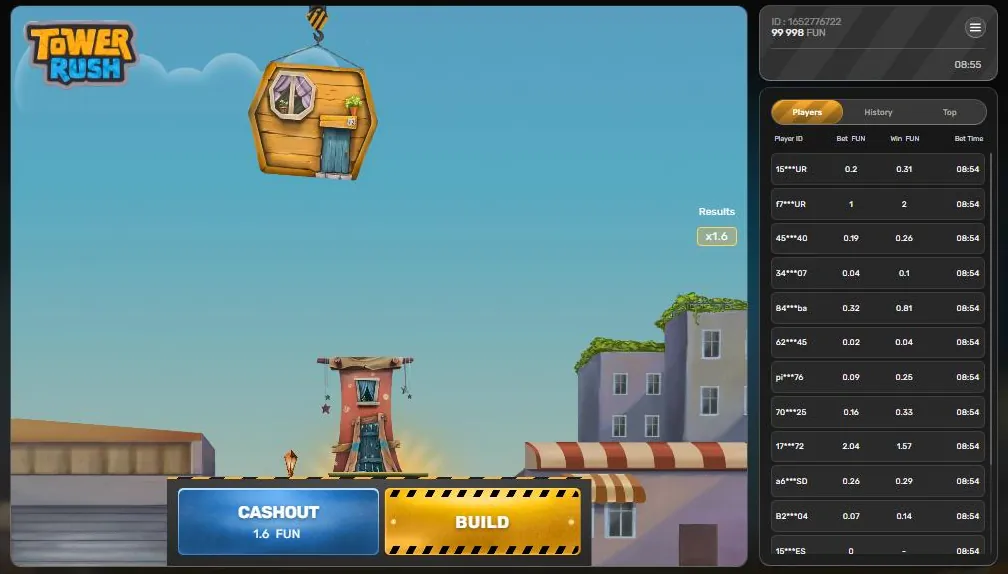
With the stake locked, building starts on an empty plot. The first floor settles, the multiplier lifts off its starting point, and the round is properly alive.
Here is the engine behind everything. Each new floor nudges the multiplier upward, so collecting at that point would pay more than a moment before. Yet every addition raises the odds that the following one topples the lot. Reward and danger rise together, in lockstep, and neither pauses to let the other catch up.
That pairing sets Tower Rush apart from games where you press a button and simply wait for a verdict. You watch value pile up while its foundations grow shakier. The early floors feel easy, because the multiplier is still modest and trouble seems far off. A few storeys later the figure looks tempting, and trouble no longer seems far off at all.
No height is guaranteed safe, and none is certain to fail. One tower may survive a long run of floors, another may fold almost immediately, and nothing reveals which kind you are facing. The one lever you hold is duration. Every extra floor is a fresh decision to accept more risk for a richer multiplier, and Tower Rush keeps posing it until you walk away or the structure gives out.
When a special floor appears
Most rounds are an ordinary run of standard floors. Occasionally, though, something different shows up. Three special floors can surface mid-round, each with its own effect:
Frozen Floor. The protective one. Whatever you had built up by the time it lands is locked in at that level, so a later fall cannot take that sum back. Building can carry on above it, and you remain free to continue, but the secured amount stays yours. Temple Floor. A special floor that brings its own rules for the multiplier. Instead of the usual steady climb, the multiplier behaves differently once this floor is involved. The specifics live in the documentation of whichever version you load, so we leave the figures out. Triple Build. A third special floor, one that reshapes how the multiplier travels. Like Temple Floor, its precise behaviour is spelled out only in the game's own rules, the one source to trust.
A few points apply to all three. None can be triggered on demand or forecast; they appear when a round produces them, and a long stretch of plain floors does not mean one is overdue. Nor do they remove the central risk, except for the portion Frozen Floor puts beyond reach.
Think of a special floor as a change in conditions rather than a hint. If Frozen Floor has protected a sum, you might feel more relaxed about carrying on, since that part cannot disappear. If Temple Floor or Triple Build turns up, remember that the rules, not a gut feeling, explain what happens next. A single read of those rules before you start spares a lot of guessing later.
Deciding when to cash out
This is the point every round builds towards. Leave at any instant before a fall and your payout equals the stake times the current multiplier, nothing more complicated. No particular height is required; quitting after the very first floor is as legitimate as quitting after twenty.
Some arithmetic helps here, offered strictly as an illustration. Imagine a stake of 0.50 CAD, collected while the multiplier reads x12. You would get 6 CAD back. That x12 is a sample chosen purely to show the sum. No floor is worth x12, and the game reaching it is not something to count on.
The awkward part is that a cash-out always looks premature or overdue once the round is over. Leave at a small multiplier and the tower may keep rising without you. Hang on for more and it may tumble one floor later.
What really helps is fixing your exit before emotion joins in. Before the first floor arrives, settle on the result that would leave you satisfied. Then honour that number as a commitment. People who bargain with themselves floor after floor usually stay longer than intended, and those extra floors are where the danger peaks.
Letting auto cash-out decide
If choosing on the spot feels stressful, you can hand the job over ahead of time. Auto cash-out is simple: before the round, you name the multiplier you want, and the exit happens by itself the instant that figure is hit.
The attraction is discipline. With a target in place, there is no itch to squeeze in another floor and no chance of freezing at the decisive second. Reach the number and the round closes in your favour. Lose the tower before then and the stake goes, just as it would had you been clicking yourself.
Let's be clear: automation does not tilt the odds. What it alters is behaviour. It strips away the in-round pressure and swaps it for a plan you made with a cool head.
When the tower collapses
Sooner or later a round ends the other way. The tower gives way with you still aboard, and whatever you staked on that round is lost. No refund, no consolation prize, with the single exception covered above: an amount already protected by Frozen Floor survives.
A fall can sting, especially after a long climb. It isn't aimed at you. Rounds are entirely separate from one another, and chance alone settles each one. This tower did not drop because the previous one stood tall, and the next will not last longer because this one fell early. Past rounds hold no pattern that points to the next collapse, however persuasive a streak might seem.
That is also why chasing losses works so badly here. Upping the stake to recover a lost round only enlarges what the next fall can claim.
The better response is unexciting but effective. Accept the loss, keep the stake you planned, and check you are still within budget before you go again.
What our Tower Rush site offers
We built this page to make Tower Rush easy to understand, so most of what it offers is what you have just read: how a round unfolds, roughly what each special floor does, and which numbers are fixed versus those set by the version a casino picks.
Alongside that, the demo is available here with virtual credits. It has the same structure you would meet when money is involved, which makes it a handy spot to rehearse a cash-out target or to notice how often you feel the pull to stay in too long.
We also try to be straightforward about limits. We do not sell predictions, signals or downloadable add-ons, and anything claiming to foresee a collapse misunderstands the game. Tower Rush is played in a browser with no app, so a file promising a special edition deserves suspicion, not a tap.
Galaxsys and Tower Rush
The game is the work of Galaxsys, whose name you will see attached to it wherever it appears. Galaxsys created the mechanics this page describes: the floor-by-floor build, the climbing multiplier, the trio of special floors and the automatic exit.
Tower Rush came out in 2026, so it is a recent arrival. It sits in the crash family, where a figure rises until something ends the round, but the tower theme gives that idea a physical form. You see a building grow rather than a curve on a chart, and the risk feels more tangible as a result.
Tower Rush is also an instant title. No reels, no paylines, no drawn-out bonus stages: each game opens, plays out and settles within moments, quite unlike a typical slot.
Worth underlining: this site is an independent page about the game, not Galaxsys. The studio develops Tower Rush and supplies it to operators, while casinos handle accounts, payments and paid sessions. For anything specific to one version, the rules shipped with it are the final word.
RTP range of Tower Rush
RTP, the return to player figure, tells you what slice of everything bet the maths hands back once millions of rounds have been played. Treat it as a long-run average, not a prediction for tonight. Over a brief spell, actual results can sit well above or well below it.
Galaxsys gives a band for this title instead of one number: the lowest published RTP is 96.15%, the highest 97.5%. That is because the studio produces several versions, and every casino selects which to install.
The practical upshot is that you should never assume the top of the band applies where you play. The precise percentage for your version appears in its rules; confirm it there, ideally while you are still playing for free.
If the figure matters to you, as it does for many, compare the rules on each site you are weighing up. A higher percentage within that band means slightly more is returned on average over time, but it never alters the randomness of one round or shields you from a fall.
Volatility and maximum win in the rules
Volatility is about how results are spread: lots of modest returns, or fewer and bigger ones. Maximum multiplier and maximum payout cap what one round can bring.
For this game, all three are written into the rules supplied with each version. We purposely quote no figures for them, because a number lifted onto an outside page might not match the version you actually load.
The rules are brief. Look for the volatility description, the highest multiplier allowed and any limit on winnings; they set expectations more honestly than forum claims or promotional messages.
Trying Tower Rush for free
The demo is the simplest route to understanding Tower Rush without spending a cent. Play uses virtual credits, so floors, special floors and collapses all behave normally, yet nothing gained or lost carries real value.
You can launch it right here, and many casino sites include it as well, although not every operator does, and some may want you logged in first.
So what is free play actually for? Practice of the unglamorous kind, mostly. Play a handful of rounds with a set exit point and see how it feels to leave with the tower still climbing. Try the automatic option at several targets.
One warning, though. Free credits take the sting out of losing, which can make reckless play feel ordinary. If you later switch to real money, bring along the habits that served you well, not the boldness that only free play excuses.
Playing on any device
Tower Rush opens straight in a web browser on phones, tablets and desktop machines alike. Nothing needs installing, and you will not need a dedicated app.
A phone squeezes the game onto a smaller display, a tablet gives the tower more breathing room, and a desktop offers the most. The rules and mechanics stay identical on all three.
Since rounds move quickly, connection quality counts. Losing signal at a decisive instant is annoying, so Wi-Fi or solid mobile coverage is preferable, particularly if you prefer clicking out by hand to setting an automatic target.
Real stakes at licensed casinos
Money can be wagered on Tower Rush only through licensed online casinos carrying Galaxsys titles, and only by adults of 18 or older. Our page accepts no deposits and runs no accounts.
Check the licence before registering anywhere. After that, look at the betting limits the operator applies to this game, as they may not stretch across the full span the studio allows, and make sure the site welcomes players in the place you live.
The usual sequence is simple: register, pass the identity verification the casino asks for, fund your account, then find the game among the instant or crash titles.
If a bonus is part of the picture, read its terms closely. Each casino decides what share of instant-game bets counts towards wagering, which titles it leaves out, and the largest bet permitted while bonus funds are in play. Those conditions are the operator's, not the game's.
Keeping Tower Rush fun
Rapid rounds are half the appeal and most of the risk. When the next game is seconds away, time and money can slip by unnoticed.
The best safeguards are put in place before you start. Fix a budget you can comfortably lose in its entirety and a session length you intend to respect. When either runs out, stop, even if the last round felt like the beginning of a hot run. Hot runs are a story told afterwards; they are not a force inside the game.
Pauses do more good than people tend to assume. A short walk away from the screen dampens the impulse to recover a loss or to stretch one floor beyond the plan.
Casinos supply tools built for this purpose: caps on deposits, caps on playing time and, when necessary, self-exclusion. Switch them on early instead of saving them for an emergency.
Should gambling stop feeling like entertainment, perhaps because you are hiding it, chasing losses or feeling anxious about it, get in contact with a professional support service for gamblers. Trained counsellors deal with this every day, and asking them early is a sensible step, never a failure.
Notes before you play Tower Rush
| Point | What it means for you |
|---|---|
| Stake range | Lowest bet 0.10 CAD, highest 100 CAD, subject to your casino's own limits |
| Cash-out | Leaving before a fall pays out your stake, multiplied by the figure at that instant |
| Collapse | Whatever you staked on that round is gone |
| Auto cash-out | A target picked ahead of the round triggers the exit automatically |
| Special floors | Frozen Floor locks in winnings at its level; Temple and Triple Build alter the multiplier's movement |
| RTP | Published band 96.15% up to 97.5%, set per version; confirm it in the rules you open |
| Volatility and maximum win | Written into each version's rules, so they may differ between casinos |
| Randomness | Rounds are unconnected, and no approach can promise a profit |
| Age | Real-money rounds only at licensed casinos, from age 18 |