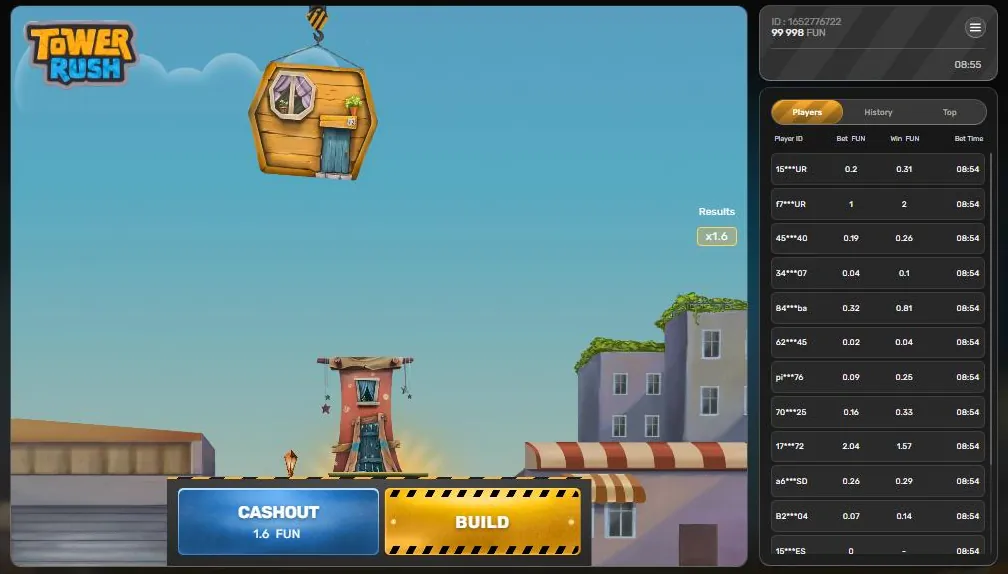
The plot is bare, the stake is set, and the first floor of Tower Rush drops into place. From that moment, Tower Rush asks you one thing, over and over: keep stacking, or pocket what the tower has earned so far?
All the rest flows from that dilemma, and it shows up quickly. One floor becomes two, then three, and the multiplier tied to your stake creeps upward with each addition. So does the tension. Nothing on the plot hints at how tall the structure can get before it gives way, and that blind spot is what makes a short round feel long.
This page follows one complete game from the empty plot to its final moment. We begin with the stake, move through the first floors and the special ones that sometimes interrupt them, and stop at the two possible endings: a cash-out or a collapse.
Once that walk-through is done, the view widens. You will find the published return figures, where to check the numbers that differ between versions, how the free demo works, which screens you can play on, and what sensible habits look like in a game built on split-second calls.
Setting the stake
A round begins before any floor appears, with the amount you commit. Tower Rush takes bets as small as NZ$0.18 and as large as NZ$180 for one round. That broad spread lets a nervous newcomer and a seasoned regular share the same game.
There is a catch. That span is the most Tower Rush permits, yet the casino running it chooses which slice you actually get. One operator might open everything; another might lift the minimum or shave the top. If the amount you wanted is missing, the game itself hasn't changed. The casino's configuration has.
A good stake is one you could lose several times running without it souring your evening. Choose the amount first, without hurry, and leave it alone unless your reason for changing it is unrelated to how the previous round went.
Placing the first floors in Tower Rush
With the stake locked, building starts on an empty plot. The first floor settles, the multiplier lifts off its starting point, and the round is properly alive.
Here is the engine behind everything. Each new floor nudges the multiplier upward, so collecting at that point would pay more than a moment before. Yet every addition raises the odds that the following one topples the lot. Reward and danger rise together, in lockstep, and neither pauses to let the other catch up.
That pairing sets Tower Rush apart from games where you press a button and simply wait for a verdict. You watch value pile up while its foundations grow shakier. The early floors feel easy, because the multiplier is still modest and trouble seems far off. A few storeys later the figure looks tempting, and trouble no longer seems far off at all.
No height is guaranteed safe, and none is certain to fail. One tower may survive a long run of floors, another may fold almost immediately, and nothing reveals which kind you are facing. The one lever you hold is duration. Every extra floor is a fresh decision to accept more risk for a richer multiplier, and Tower Rush keeps posing it until you walk away or the structure gives out.
When a special floor appears
Most rounds are an ordinary run of standard floors. Occasionally, though, something different shows up. Three special floors can surface mid-round, each with its own effect:
Frozen Floor. The protective one. Whatever you had built up by the time it lands is locked in at that level, so a later fall cannot take that sum back. Building can carry on above it, and you remain free to continue, but the secured amount stays yours. Temple Floor. A special floor that brings its own rules for the multiplier. Instead of the usual steady climb, the multiplier behaves differently once this floor is involved. The specifics live in the documentation of whichever version you load, so we leave the figures out. Triple Build. A third special floor, one that reshapes how the multiplier travels. Like Temple Floor, its precise behaviour is spelled out only in the game's own rules, the one source to trust.
A few points apply to all three. None can be triggered on demand or forecast; they appear when a round produces them, and a long stretch of plain floors does not mean one is overdue. Nor do they remove the central risk, except for the portion Frozen Floor puts beyond reach.
Think of a special floor as a change in conditions rather than a hint. If Frozen Floor has protected a sum, you might feel more relaxed about carrying on, since that part cannot disappear. If Temple Floor or Triple Build turns up, remember that the rules, not a gut feeling, explain what happens next. A single read of those rules before you start spares a lot of guessing later.
Deciding when to cash out
This is the point every round builds towards. Leave at any instant before a fall and your payout equals the stake times the current multiplier, nothing more complicated. No particular height is required; quitting after the very first floor is as legitimate as quitting after twenty.
Some arithmetic helps here, offered strictly as an illustration. Imagine a stake of NZ$0.9, collected while the multiplier reads x12. You would get NZ$11 back. That x12 is a sample chosen purely to show the sum. No floor is worth x12, and the game reaching it is not something to count on.
The awkward part is that a cash-out always looks premature or overdue once the round is over. Leave at a small multiplier and the tower may keep rising without you. Hang on for more and it may tumble one floor later.
What really helps is fixing your exit before emotion joins in. Before the first floor arrives, settle on the result that would leave you satisfied. Then honour that number as a commitment. People who bargain with themselves floor after floor usually stay longer than intended, and those extra floors are where the danger peaks.
Letting auto cash-out decide
If choosing on the spot feels stressful, you can hand the job over ahead of time. Auto cash-out is simple: before the round, you name the multiplier you want, and the exit happens by itself the instant that figure is hit.
The attraction is discipline. With a target in place, there is no itch to squeeze in another floor and no chance of freezing at the decisive second. Reach the number and the round closes in your favour. Lose the tower before then and the stake goes, just as it would had you been clicking yourself.
Let's be clear: automation does not tilt the odds. What it alters is behaviour. It strips away the in-round pressure and swaps it for a plan you made with a cool head.
When the tower collapses
Sooner or later a round ends the other way. The tower gives way with you still aboard, and whatever you staked on that round is lost. No refund, no consolation prize, with the single exception covered above: an amount already protected by Frozen Floor survives.
A fall can sting, especially after a long climb. It isn't aimed at you. Rounds are entirely separate from one another, and chance alone settles each one. This tower did not drop because the previous one stood tall, and the next will not last longer because this one fell early. Past rounds hold no pattern that points to the next collapse, however persuasive a streak might seem.
That is also why chasing losses works so badly here. Upping the stake to recover a lost round only enlarges what the next fall can claim.
The better response is unexciting but effective. Accept the loss, keep the stake you planned, and check you are still within budget before you go again.
What our Tower Rush site offers
We built this page to make Tower Rush easy to understand, so most of what it offers is what you have just read: how a round unfolds, roughly what each special floor does, and which numbers are fixed versus those set by the version a casino picks.
Alongside that, the demo is available here with virtual credits. It has the same structure you would meet when money is involved, which makes it a handy spot to rehearse a cash-out target or to notice how often you feel the pull to stay in too long.
We also try to be straightforward about limits. We do not sell predictions, signals or downloadable add-ons, and anything claiming to foresee a collapse misunderstands the game. Tower Rush is played in a browser with no app, so a file promising a special edition deserves suspicion, not a tap.
Galaxsys and Tower Rush
The game is the work of Galaxsys, whose name you will see attached to it wherever it appears. Galaxsys created the mechanics this page describes: the floor-by-floor build, the climbing multiplier, the trio of special floors and the automatic exit.
Tower Rush came out in 2026, so it is a recent arrival. It sits in the crash family, where a figure rises until something ends the round, but the tower theme gives that idea a physical form. You see a building grow rather than a curve on a chart, and the risk feels more tangible as a result.
Tower Rush is also an instant title. No reels, no paylines, no drawn-out bonus stages: each game opens, plays out and settles within moments, quite unlike a typical slot.
Worth underlining: this site is an independent page about the game, not Galaxsys. The studio develops Tower Rush and supplies it to operators, while casinos handle accounts, payments and paid sessions. For anything specific to one version, the rules shipped with it are the final word.
RTP range of Tower Rush
RTP, the return to player figure, tells you what slice of everything bet the maths hands back once millions of rounds have been played. Treat it as a long-run average, not a prediction for tonight. Over a brief spell, actual results can sit well above or well below it.
Galaxsys gives a band for this title instead of one number: the lowest published RTP is 96.15%, the highest 97.5%. That is because the studio produces several versions, and every casino selects which to install.
The practical upshot is that you should never assume the top of the band applies where you play. The precise percentage for your version appears in its rules; confirm it there, ideally while you are still playing for free.
If the figure matters to you, as it does for many, compare the rules on each site you are weighing up. A higher percentage within that band means slightly more is returned on average over time, but it never alters the randomness of one round or shields you from a fall.
Volatility and maximum win in the rules
Volatility is about how results are spread: lots of modest returns, or fewer and bigger ones. Maximum multiplier and maximum payout cap what one round can bring.
For this game, all three are written into the rules supplied with each version. We purposely quote no figures for them, because a number lifted onto an outside page might not match the version you actually load.
The rules are brief. Look for the volatility description, the highest multiplier allowed and any limit on winnings; they set expectations more honestly than forum claims or promotional messages.
Trying Tower Rush for free
The demo is the simplest route to understanding Tower Rush without spending a cent. Play uses virtual credits, so floors, special floors and collapses all behave normally, yet nothing gained or lost carries real value.
Vous pouvez le lancer juste ici, et plusieurs sites de casino l'incluent également, bien que tous les opérateurs ne le fassent pas, et certains voudront peut-être que vous soyez connecté au préalable.
Alors, à quoi sert réellement le jeu gratuit ? À un entraînement peu glamour, principalement. Jouez quelques tours avec un point de sortie défini et voyez comment il est de partir avec la tour encore en train de grimper. Essayez l'option automatique sur plusieurs cibles.
Cependant, une mise en garde. Les crédits gratuits atténuent la douleur de la perte, ce qui peut rendre le jeu imprudent ordinaire. Si vous passez ensuite à de l'argent réel, emportez avec vous les habitudes qui vous ont bien servi, et non l’audace que seul le jeu gratuit excuse.
Jouer sur n'importe quel appareil
Tower Rush s'ouvre directement dans un navigateur web sur les téléphones, tablettes et ordinateurs de bureau. Rien n'a besoin d'être installé, et vous n'aurez pas besoin d'une application dédiée.
Un téléphone comprime le jeu sur un plus petit écran, une tablette donne plus d'espace à la tour, et un bureau offre le plus d'espace. Les règles et la mécanique restent identiques sur les trois.
Étant donné que les tours avancent rapidement, la qualité de la connexion compte. Perdre le signal à un instant décisif est ennuyeux, donc le Wi-Fi ou une bonne couverture mobile est préférable, surtout si vous préférez cliquer manuellement plutôt que de définir un objectif automatique.
Jouer avec de l'argent réel dans des casinos agréés
De l'argent peut être misé sur Tower Rush uniquement via des casinos en ligne agréés portant des titres Galaxsys, et seulement par des adultes de 18 ans ou plus. Notre page n'accepte aucun dépôt et ne gère aucun compte.
Vérifiez la licence avant de vous enregistrer n'importe où. Après cela, regardez les limites de mise que l'opérateur applique à ce jeu, car elles peuvent ne pas couvrir toute l'étendue que le studio autorise, et assurez-vous que le site accueille les joueurs dans votre pays.
La séquence habituelle est simple : inscrivez-vous, passez la vérification d'identité demandée par le casino, alimentez votre compte, puis trouvez le jeu parmi les titres instantanés ou crash.
S'il y a un bonus dans le tableau, lisez attentivement ses conditions. Chaque casino décide quelle part des mises de jeux instantanés compte pour le playthrough, quels titres il exclut, et la plus grande mise autorisée pendant que les fonds bonus sont en jeu. Ces conditions sont celles de l'opérateur, pas du jeu.
Garder Tower Rush amusant
Des tours rapides sont la moitié de l'attrait et la plupart du risque. Lorsque le prochain jeu est à quelques secondes, le temps et l'argent peuvent passer inaperçus.
Les meilleures protections sont mises en place avant que vous ne commenciez. Fixez un budget que vous pouvez perdre entièrement et une durée de session que vous comptez respecter. Quand l'un ou l'autre se termine, arrêtez, même si le dernier tour semblait être le début d'une série gagnante. Les séries gagnantes sont une histoire à raconter après ; ce ne sont pas une force à l'intérieur du jeu.
Les pauses sont plus bénéfiques que ce que les gens tendent à supposer. Une courte marche loin de l'écran atténue l'impulsion de récupérer une perte ou d'étirer une étage au-delà du plan initial.
Les casinos fournissent des outils conçus à cet effet : limites de dépôts, limites de temps de jeu et, lorsque nécessaire, auto-exclusion. Activez-les tôt au lieu de les garder pour une urgence.
Si le jeu ne ressemble plus à un divertissement, peut-être parce que vous le cachez, que vous courez après des pertes ou que vous vous sentez anxieux à son sujet, contactez un service de support professionnel pour les joueurs. Des conseillers formés traitent cela chaque jour, et leur demander de l'aide tôt est une étape sensée, jamais un échec.
Remarques avant de jouer à Tower Rush
| Point | Ce que cela signifie pour vous |
|---|---|
| Plage de mise | Mise minimale NZ$0.18, maximale NZ$180, sous réserve des propres limites de votre casino |
| Retrait | Quitter avant une chute rembourse votre mise, multipliée par le chiffre à cet instant |
| Effondrement | Tout ce que vous avez misé sur ce tour est perdu |
| Retrait automatique | Un objectif fixé avant le tour déclenche la sortie automatiquement |
| Étages spéciaux | Le Sol Gelé verrouille les gains à son niveau ; Temple et Triple Build modifient le mouvement du multiplicateur |
| RTP | Bande publiée 96.15% jusqu'à 97.5%, fixée par version ; confirmez-le dans les règles que vous ouvrez |
| Volatilité et gain maximum | Indiquée dans les règles de chaque version, elles peuvent donc différer entre les casinos |
| Aléa | Les tours ne sont pas connectés, et aucune approche ne peut promettre un profit |
| Âge | Tours en argent réel uniquement dans des casinos agréés, à partir de 18 ans |